PDA

View Full Version : Gybing Techniques / Associated Boom Gear


Martin King
12-21-2002, 08:23 PM
Originally posted by cajmills
I plan on going offshore and consider the rudder modification as a priority.

An excellent top priority! The 37 was designed by my dad
for the 1 ton cup and we owned hull #1 for a while and
campaigned her heavily. She would not be my first choice
for a round the world cruise but that's just my opinion. The
37, 39, and 46 all have similar underbodies and rather
smallish rudders. After discussing this issue with my
dad, I lengthened the rudder on my old 39 about 8 inches
while maintaining the same profile. This was easily accomplished
because the Foss company still has the OEM rudder mold. I
don't know if the 37 mold still exists but you might check with
them. If you are really serious about this mod, email me
off list and I would be happy to go over the details with you.

Martin

Lawdog
10-24-2005, 05:43 PM
I currently drive a 1983 E 38, and had a wild ride from Oxnard to Newport in the feeder race for the Newport/Ensenada Race last year. I had purchased the boat in Oxnard (I live in Maine) and outfitted her in Oxnard. My maiden voyage on the 38 was with one other friend in this feeder race. We left Oxnard Channel with about 20 knts at 1 pm start time, and figured that since we were heading pretty much on a broad reach, no problem for 20 kts. Of course, after about a hour and 1/2, the wind was gusting to over 30, and we were broaching fairly frequently, and the waves had picked up to 10 to 12 feet. Steering this boat was a monster job, so I rolled the jib in to the second reef mark, and reefed the main to the first reef. Still broaching, but less often, I rolled the jib in the rest of the way and put a second reef in the mainsail. This finally made the 38 somewhat controllable, although we still hit 10.5 kts surfing on a regular basis, and I remember hitting 11.4 kts at one point. We crossed the finish line in Newport Harbor just before midnight. The 38 remianed a bear to drive, requiring lots of muscle in anthing over 20, so I went underneath the steering station and found that the bearings for the sheaves were junk. I have since replaced them and can say that she handles much easier, but not great. Any extension on the rudder would cause the rudder to hit the bottom before the keel (6'6") and I dont want to risk that kind of damage. I will be adding an adjustable backstay, and full battened main next year, both of which will help in stronger winds. I talked to Bruce King about this, and he said the single most significant and costs effective improvement is to invest in a full battened main. I have also talked with several people who own 38's about modifying the keel by adding a bulb, and everyone who has done that, swears by it.
I did have a 1976 E 29, which broached in anything over 20, and added onto the rudder with fantastic results, but the rudder on the 29 is like a shark fin, and gets smaller as it gets deeper, so everytime you heel, you lose control.
Neal

NateHanson
10-28-2005, 03:34 PM
Personally, I'd never permit a gybe "all-standing". The pressures on the rig, and particularly on a boom that has mid-boom sheet attachment, is huge, and the probability of failure is probably higher than any other maneuver we might do. I can't imagine putting that much stress on my rig on purpose.

In all but light air (when I simply guide the bundle of mainsheet across the cockpit by hand, using my weight to gybe the roach across) I quickly sheet the boom in to midships, gybe it over and immediately ease it out while remaining as close as possible to ddw (to prevent a broach). If you don't have the crew to do this properly I would suggest tacking around instead of gybing.

Regardless of whether I have sufficient crew, I don't gybe in greater than 25 knot winds or in a large swell (which makes it difficult to hold the boat downwind and rolls the boat, both making a broach more likely).

But even in any wind conditions I never allow the boom to gybe freely across. I think such a practice is inviting disaster, and contributes to premature wear of components.

Nate

u079721
10-28-2005, 11:07 PM
Well, it probably isn't very seamanlike or pretty, but the few times I was singlehanding down wind and needed to jibe I decided to just come up into the wind and then tack. It shoots the hell out of your boat speed, but it is a way to get the boom on the other side of the boat downwind without an uncontrolled jibe.

Loren Beach
10-29-2005, 12:22 PM
Doing a tack clear around in order to gybe the boom is the time-honored way to avoid damage when in bigger winds. I used to know a racer that called this a "chicken gybe"... and he used it too!
Loren

NateHanson
10-29-2005, 01:42 PM
"chicken gybe". :) I like that.

evm
10-29-2005, 01:51 PM
For gybing I've always sheeted in a bit and then grasped the sheet in the middle between the blocks and pulled with a good tug. This brings the boom to centerline and the roach will then move over pulling the rest of the sail over.

As the sheet comes "loose" pull the rest in you as you can and then as the wind fills the sail let the sheet go back into the blocks as slowly as you can.

Holding the sheet acts as a shock asorber and with the mechanical advantage of the blocks allows a smooth gybe.

Of course in strong winds there are a lot of forces but you do reef down of course.

Roger Ware
11-01-2005, 05:36 PM
If you've had experience gybing a racing dinghy in strong winds, it may help with gybing a big boat. On my 505 I would always reverse the helm hard as the boom came over, and keep praying hard. As far as single handed gybing goes, what about steering to ddw, put the boat on AP, crank the boom half way in, dial in another 20 degrees on the AP, crank the sail in the rest of the way as the boat steers through the gybe.

Assuming you have an autopilot, that is.

Cheers, Roger in Kingston, ON

Seth
11-02-2005, 12:51 PM
Nice idea, Roger, but in the conditions where you are nervous enough about gybing to do this, the boat will be much too squirrely ddw for the autopilot to steer with that much precision. If you are alone, and it is that hairy, I would tack around!

Yes, I owe you some paperwork-it is coming!

Cheers,
S

Roger Ware
11-02-2005, 01:00 PM
I intended to add that I hadnt tried my AP gybe, and I am sure that Seth is right, although my 8001 system seems to steer better than I do most of the time. Of course, reading Seth's earlier post again, I realize that after setting the AP to "GYBE" you should be sheeting out, not in, at that point. And I defintely wasnt intending the undermine the merits of the Chicken Gybe.

Cheers, Roger

Geoff Johnson
11-02-2005, 01:32 PM
One thing that hasn't been factored in is the preventer that should be used for downwind sailing. On my boat I use the soft vang attached to the outboard track, but ideally one should have lines run forward and back to the cockpit.

Seth
11-02-2005, 01:50 PM
Roger,

I know you were not making any such implication-this is a good discussion for sure, and is how we all learn!

Geoff,

Preventers do have a place on most sailboats, but for me, the only useful and safe way to use them is in light-moderate air, when the boom is moving in an out from LACK of pressure keeping it out, or if sailing deep (but never in big air when a gybe is at all dicey) but having the same issue (wind pressure will not keep it out there). For me, this is the ONLY safe way to use them.

If you cannot, for whetever reason, keep the boat under control downwind so that there is no fear of accidental gybes, you must either head up or gybe, but DO NOT sail a course like that in these conditions. If you gybe accidentally WITH a preventer, you will either pin the boat under the main, or break something when the preventer lets go (or hurt someone).

The idea of being laid over in an accidental gybe, and then "easing" the preventer line, is not a good or sfae one-certainly nothing I would allow on any boat I sail offshore on.

When the breeze gets up, the preventer goes below. Period.

My apologies if this was understood already, Geoff-I would thing you already knew this, but I did want to make the point since I often hear of sailors using these things to "prevent" accidental gybes-which they certainly do not do.

Light air broad reaching and running-sure-go for it! In fact, the 35-2 and 39's almost need this-as the conventional vang sometimes does not do the trick with the standard layout....

Another tuppence for the day :devil:

Geoff Johnson
11-02-2005, 02:42 PM
Seth,

I don't have your sailing experience, but the experience/instruction I have received indicates that a preventer should be used. A few years ago I crewed a 42' Swan from Newport to Bermuda. Part of the trip was down wind in Force 9 and 10 conditions flying only a triple reefed main. The skipper failed to rig a preventer and we were not able to prevent uncontroled gybes in the 20 to 30 foot following seas. At 2 am, on my watch, the boom broke about a foot from the goose neck. We were lucky it did not bring down the rig. (As you can imagine getting the boom back on board and the tattered sail down was a nightmare. Those waves were like freight trains coming out of the night.) All the other boats in the flotilla had rigged preventers and came through with booms intact.

I can see your point about what can happen with the preventer attached in a broach, but in those conditions, running was the only option. I suppose we could have taken down the main and rigged a small jib, but an attempt to turn the boat into the wind to accomplish it could have been catastrophic.

I have also spent a couple of weeks on a 65 boat. The skipper (currently the skipper of one of the boats in the Clipper Round the World Race) had an ironclad rule that the preventer was to be rigged whenever the boat was not going to weather.

This SailNet article by John Rousmaniere seems to confirm this approach:

http://www.sailnet.com/collections/articles/index.cfm?articleid=rousma0049

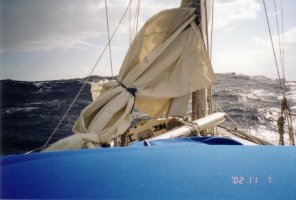
Here's a photo of the mess after the storm blew through:

NateHanson
11-02-2005, 03:34 PM
Again I don't have the extent of offshore experience as is sounds like some of you do, but my understanding has been that an offshore preventer (one run to the BOW rail, not let straight down to the rail) is used in heavy conditions because it will prevent a gybe if the boat is pushed slightly to the lee. It won't prevent dissaster in the case of a major mis-steer, but it won't allow the boom to be thrown over violently when the boat is ddw, and gets rolled to weather by a large wave. While I agree with Seth that I'd never want to have my boat pinned under a backwinded main, held up by a preventer after a gybe, I'd much rather keep the boom intact, and I think allowing an all-standing gybe greatly runs that risk, as Geoff's experience illustrates.

In the case of a broach, it's very important to run the preventer to the bow (and lead the control end back to a cockpit winch) rather than use a vang, or tie a preventer straight down to the rail, because if the boom were to drag in the water in a broach under heavy conditions, the boom would be in danger of breaking.

On the same subject, did anyone here see the video footage about 4 years ago from the Volvo Ocean Race, when an Open 50 did a death roll under spinnaker at 20 knots before arriving in Sydney? Incredible video tape! The boat was completely laid over to windward, with the boom held up by a preventer and the spinnaker shredding itself. The bulb keel was parallel to the water surface, and it took about a minute for the boat to get back on it's feet (spin cut away, and preventer eased). Crew were tucked between the windward lifelines on the rail, and were held underwater for that time, until the boat righted! :eek:

Geoff Johnson
11-02-2005, 03:53 PM
Booms in the water are bad. A member of my club crewed on the Albatross (the boat in the movie "White Squall") and was on the boat when it went down. He claims the problem was not particularly severe weather or shifting ballast, but the sail plan. It had a fore and aft sail with a very long boom off the stern that became buried in the water. Normally, the boat would round up, but because of its square sails on the fore mast, it was prevented from doing so and so it was held on its beam ends until it filled.


I agree with Nate about not using the vang. I do use one instead of a preventer, but only in light airs where there is no chance of burying the boom.

boatboy
11-02-2005, 05:15 PM
Two words: Boom Brake. As far as I can tell, this device gives you all of the advantages of a preventer, but none of the dangerous disadvantages. I have not yet installed one on our E-39, but I had a Dutchman on my previous boat and liked it very much. In light air it acts exactly like a preventer, but if you accidentally gybe in heavy air it will allow the boom to come across slowly.

Geoff Johnson
11-02-2005, 06:46 PM
The Boom Brake is mentioned in the Rousmaniere article.

NateHanson
11-02-2005, 07:05 PM
I've been interested in the boom brake too, but it seems that it would get awfully annoying to climb over it every time you go forward (I believe it stays permanently rigged). Also it could be a liability for the boom in heavy weather because it holds the boom down, and if the boom hits the water it could snap.

boatboy
11-03-2005, 10:33 PM
The boom brake does not hold the boom down any more than the vang does. Both vang and brake control lines can be led to cleats which can easily be released if necessary.

ted_reshetiloff
11-04-2005, 11:48 AM
Can we strip this thread out of the rudder modification one and create its own in another forum like crusing and racing? There is very valuable discussion going on here and it would be easier to locate at a later date if it was its own thread. Moderator?

Loren Beach
11-04-2005, 12:19 PM
I tried to pick out the relevant "gybing" posts from the Thread Splitting function that is open to Moderators. I hope this has not misplaced any relevant material from either train of thought.
:rolleyes:
Ted is right about the need for a separate thread, and I have been contemplating this move for several days. This is a first attempt, on my part.
If you all spot some portion of your essay that now is misplaced... please recreate it in the proper thread.

[ I now have a better understanding of the problem that Apprentice Mickey had in the old movie annimation "Fantasia". Remember those brooms and the water?]
:)

Loren

ted_reshetiloff
11-04-2005, 03:47 PM
I was reading the article on Sailnet that is referenced above. Boom brake sounds like something I could use for single handed gybes in heavy air? I haven' t read up on it entirely but it sounds like it will allow the boom to cross slowly thereby eliminating the "crash gybe". I have never used preventers in heavy air for the reasons mentioned above, but perhaps if they were rigged differently I might consider it. My whole focus here is beng able to handle the boat comfortably DDW in 20kts or more with a good sea running. On another topic, without using the engine I am not sure how the folks on that swan mentioned above would have tacked the boat in force 10 with those kind of seas. Shame the boom broke though.

Geoff Johnson
11-04-2005, 04:09 PM
Yes, we broke the boat, but at least no one was hurt. Some of the boats had and rigged storm sails. We didn't have any, so we had no business being 300 miles offshore in November. I'll know better next time. Of course once the storm hit, there wasn't much we could do except hang on and hang on I did. The routine in going on watch was to bash your head into the sides of the boat a few times while struggling into your foul weather gear, barf into the head, and come on deck to be greeted by a firehose. At one point the wind blew the Lifesling overboard and it took two grown men to haul in an empty Lifesling. Anyone clipped to a jackline who went overboard would have drowned for sure so there was no question of leaving the cockpit to tame the boom. Following the storm we discovered that the VHF antenna and anenometer had been swept from the top of the 60 foot mast. We surmised that the mast head (the boat was pretty well laid on its side during the height of the storm and jumping off waves), had an encounter with a very significant wave.

ted_reshetiloff
11-04-2005, 05:01 PM
So how exactly do you gybe in those conditions? Single handled that is....

NateHanson
11-04-2005, 05:08 PM
In extreme conditions?

I would absolutely tack around (chicken gybe) if sailing singlehanded in heavy weather. You need to exercise an extra measure of caution when alone, because you don't want to create a problem you can't solve alone, and you certainly don't want to put yourself at risk of going overboard. So I'd be undercanvassed for starters, douse the spin (if flying one), have the auto steer upwind, and sheet in the main (and jib if set) as the boat gradually comes up to a beat, then tack the boat with the autopilot, and when you're set on the next tack bear off to your desired course.

ted_reshetiloff
11-04-2005, 05:39 PM
Have you tried to bring a boat around from DDW in force 10 conditons with 30 to 40 foot seas? My guess is it would be pretty hard to get enough headway to make it through irons with waves like that, but maybe not.

Geoff Johnson
11-04-2005, 05:52 PM
I think the answer is to have proper sails to begin with, i.e a storm trysail (no boom) and a storm jib.

http://www.sailnet.com/collections/articles/index.cfm?articleid=davisd0019

Or run under bare poles. There is a beautifully written book entitled Saga of Simba (1939), where the little sloop encountered a similar storm in the same part of the Atlantic north of Bermuda, and ran for two days until the storm blew out. Then they had to beat back to Bermuda.

I should add that what really kept our bacon out of the fire was a robust below decks autopilot. It would have too exahausting to to steer more than a few minutes in those conditions and too dangerous to be at the wheel.

NateHanson
11-04-2005, 05:58 PM
Is this really a situation you see yourself getting into? Maybe you're just having thought experiment, but personally I don't think of singlehanding in Force 10 conditions with spreader height waves as my idea of fun, so I'd probably avoid the situation. But if I were to find myself in that position, I think the last thing I'd do is leave the helm to gybe the main. I'd probably hang the hell on, and just stay on that tack until things started to calm down a bit.

In my opinion you're in storm survival mode if single-handed in that situation. Conditions that might be a stiff blow for a full crew are much different for a single hander. Your options are severely limited when alone, especially if your boat won't steer itself in those conditions (either by windvane or very capable auto).

ted_reshetiloff
11-04-2005, 06:05 PM
Yeah I hope to never end up in that situation, but I am certain that ofshore racers encounter it in the southern ocean frequently. How do they gybe in those conditions (single handers that is)? or do they? I am thinking the trysail would be the way to go for sure. How about this dutchman boom brake? Does anyone here have experience with it? Seems like a good idea but I wonder just how wellit works in 20-25kts as a brake? Sounds like you need to set the tension on it to allow the boom to cross, but slowly. How many crash gybes does that take to figure out? Its an interesting looking device that looks liek it should work.

Geoff Johnson
11-04-2005, 06:10 PM
You are obviously not going to find those wave conditions in coastal waters, but I have been caught in a squall on Long Island Sound where the winds topped 60 knots, the waves rose to six feet in minutes, the sky turned to night and lightning was striking all around. I don't mind admitting that I was scared. My response when I saw it coming, which proved to be correct, was to head back out to open water, furl all sails, and run before it under power. Of course, that storm lasted only 20 minutes, but some sailors did perish.

NateHanson
11-04-2005, 06:10 PM
The southern ocean boats are downwind sleds. They handle extremely differently in these conditions than our boats, and the electric autopilots those racers carry are worlds ahead of those we typically put on our boats.

What I'd worry about with the boom brake in these sorts of conditions is whether the main could be eased out again fast enough. The worst spot to be in, is with that boom sheeted all the way in. If the next wave rolls you before you can let the main all the way out, you'll either gybe back, or broach violently.

hodo
11-04-2005, 06:52 PM
You are obviously not going to find those wave conditions in coastal waters, but I have been caught in a squall on Long Island Sound where the winds topped 60 knots, the waves rose to six feet in minutes, the sky turned to night and lightning was striking all around. I don't mind admitting that I was scared. My response when I saw it coming, which proved to be correct, was to head back out to open water, furl all sails, and run before it under power. Of course, that storm lasted only 20 minutes, but some sailors did perish.
Geoff, I think my first response would be to get out my brown pants. Hodo.

Geoff Johnson
11-04-2005, 07:18 PM
Wait, there is more. It wasn't my boat and when I asked my friend, the owner, where the life jackets were, he replied "In the attic". I did spend part of the time on my knees, but I prefer to think that it was only to keep the blinding rain out of my eyes. We closed his wife up in the cabin with my wife and I am reliably informed that his wife was screaming "We are going to die" between attempts to raise the CG (which was otherwise occupied).

Loren Beach
11-04-2005, 07:53 PM
Three years ago I was crew on a delivery of a Cascade 36 down the coast form Astoria to SF. All but the last day was with a Monitor vane steering. Off northern California we were in a clear-air gale off Cape Mendoceno for 36 hours -- seas breaking in all directions. Fifty miles offshore, we ran with a reefed stays'l only. After running for a prior day with a double-reef, main and boom were then lashed down. I do not believe that we could have safely done a tack in place of a gybe -- seas were routinely running 19 feet.

No damage except that the air paddle was badly fractured and was replaced in SF. The white tumbling wave tops were both beautiful in full sun and under a full moon, and frieghtening, in equal measure. Took some cross seas over the cabin and got pooped once in the wee hours. :eek:

I think that both the force of a gybe could break a gooseneck and also there is the real possibility of a round up-and-down and planting the boom in the water... Yikes!
:(
That particular boat has a hard dodger with a gallows on which to lash down the boom. Darned good thing, too!

Interesting how so many of you have wrung more sea water out of your socks than I have sailed over! :rolleyes:
My little adventure sounds kinda tame compared to some of yours...

Best,
Loren in PDX
Olson 34 Fresh Air

boatboy
11-05-2005, 12:40 PM
Nate,

In actual practice I don't think you'd use the boom brake while gybing on purpose. It's too difficult to sheet in the main if the brake is strongly activated. I think the boom brake is best used to prevent accidental gybes in light air, or prevent damage if accidentally gybing in heavy air.

Guy Stevens
11-05-2005, 02:31 PM
The boom brake could be used in an intentional gybe. One end is dead ended to whatever (Hopefully whatever strongly attached to the boat), the other end goes through a block to a wench. You can tighten or loosen the brake depending on what you want it to do. It works like a belaying device in climbing, you can stop with it, or you can slowly repel (abseil to those living upside down :-) ).

We had one aboard Pneuma, came with the boat... Having done a lot of sailing without one I thought it was a ridiculous piece of gear..........Until I put some inexperienced crew at the wheel in a gusty day, and watched what happened when they were steering. Inexperienced crew and exhausted crew act a lot the same I noticed.

As for Trysails,,,,, I find that they are only usable on boats that have boom gallows. NO gallows, then what are you going to do with the boom???? It swings around a bunch when not in use let me tell you (Yeah you can tighten up that sheet till you pull the traveler off the deck and it makes no difference! :-)) Lash it to the deck? Right, then you have successfully made it at least twice as hard to get to the foredeck to deal with the inspection and any problems that occur up there, and you have reduced your visibility even more. (You can hardly see anyway why make it worse???).

Back to the boom brake... In really bad errr... stuff, they will bring the boom across slowly, (Plenty of time to duck, and slow enough that it won't strike your head only push it out of the way.) What I found cool was the amount of noise that they make while doing this. Kind of a OHSHITGYBE alarm, I can't describe noises on the net, but they do make a good deal of it if they are trimmed correctly and you gybe.

Worst weather we were in was off the coast of New Zealand, somewhere that I would not sail to again no matter what you were paying (Ok maybe, but I doubt that anyone would pay that much... ;-) ) The wind was sustained at over 85 knots, gust to something that my anemometer could not measure, and the seas were 45 feet and at their worst very organized .)

We got knocked down twice by breaking waves (not pushed over by the wind!). The boom brake did a wonderful job in these conditions, so did the triple reefed main, the Ericson Hull construction when the next wave broke ON US, the wind vane steering (Right up till the knock downs), and mere minutes later the parachute sea anchor did amazing things I would not have believed possible from a piece of fabric with some strange darts in it!!! ( It is a really long story about really strange weather and sea state changes happening faster than I would have ever thought possible....)

We sat that out under sea anchor for two days. Four boats were lost, three others abandoned and all of us had scars to show when we reached Tonga. (Boat, human, and psyche). Now whenever anyone says that Ericsons are not really good sea boats, and that they would rather have heavy crabcrusher X, I just smile… Occasionally I’ll ask how many sea miles they have on crab crusher X, then go HMMMM….. and let them continue…

Back to the boom brake.... I did not like constantly having to get over the lines to get to the foredeck, I hated it most days, however it did work better than advertised. I plan on doing some experimenting on the 46 and seeing how well the end of the boom preventer works. I suspect that I am going to go back to swearing at a boom brake and the lines across the deck though.

For short handed crew using auto steering devices, I would say that either permanently rigged preventer or a boom brake is a very important safety device. Those auto steering devices do fail, and can send the boat into a gybe just when you are walking up to see how well that modeling clay in the hawse pipe is holding up..... I am more concerned after the 40,000 miles that we did in the big blue with the boom hitting a crewmember than I am about getting pasted to the life lines in a Vende Globe boat :-). (But that could just be that I have never been invited to sail on a Vende Globe boat ??? :-) )

Guy
:-)

Geoff Johnson
11-05-2005, 05:46 PM
Beyond 40 degrees south there is no law. Beyond 50 degrees south there is no God.
-- 19th century whaler's saying

ted_reshetiloff
11-07-2005, 09:58 AM
Guy,

Sounds like you would recommend the boom brake then? I am curious if it will help me pull off gybes singlehanded in say 20-25kts. We rarely see anything over 25 on the chesapeake and in fact don't often see 20. I dont have any offshore aspirations for this boat for a few more years and even then its only going to be up tp New England, Maine, or Nova Scotia. No pond crossings. It would be great however if this device would allow me to set it up, then when I was ready to gybe just throw the helm over and let the boom brake do its thing. I am not sure though if that is possible, and if it ends up needing two people to pull it off then its not really worth it to me. I can and do rig a preventer so that funtion is already taken care of. I worry about the sail being let out enough after the gybe. Someone mentioned that earlier, and if it does not go out enough you will likely round up after the gybe is completed, then risking a broach? Good thread here guys, I appreciate the input.

NateHanson
11-07-2005, 04:41 PM
I'm sure guy can give a more complete answer, but I'd venture that if you had your boom all the way out (ddw) and threw the helm over without sheeting it in, you'd turn about 50 degrees before the roach was backwinded and the boom started to gybe across. So you'd be gybing with the wind on your beam in heavy weather, and that sounds like a good way to get a cockpit full of water (broach).

FWIW, passaging between Mass and Maine, I've more often than not had winds over 25 knots at some point in the trip (the other half of the trips we don't see winds over 10 knots :rolleyes: )

ted_reshetiloff
11-08-2005, 08:57 AM
Nate I think your right here. I guess there is not free lunch. I 'll just have to buy some electric winches with remote controls to gybe that sucker... Hopefully my crew/wife will be able to help more when the kids are a little bigger and she doesn't need to sit with them below when ever we get bad weather.

NateHanson
11-08-2005, 09:42 AM
Could you sheave the mainsheet back to the a winch near the helm? That way you could crank it in and gybe without leaving the helm.

ted_reshetiloff
11-08-2005, 09:59 AM
Maybe, but I think I would need to first have 1 turn around the cabintop winch to keep the lead fair. I suppose it could be worth a try...

Seth
11-16-2005, 06:29 PM
Sorry for the long delay guys. I may have a bit overly zealous iin my answers on this topic, but I have seen as many broken booms and injuries from being pinned, or having the preventer break, as from not.

I would have to agree that there are times when it makes some sense (although I would be more likely to use it in the ligher air to keep the boom from moving too much), and when running in very rough conditions it could help keep the main from fllying across if you stick it by the lee a bit too far..I am just biased by seeing so many people not really have the ability to get the boat that deep without going too far, and getting pinned. That is why I tend to suggest they reach up a few degrees if they can't control the boat ddw.

Still, I'll back off on the position-still you won't often see it on anything I sail on.

Sorry for the zealousness-you guys know how I get sometimes!

Cheers