View Full Version : Hurth HBW 50 & Things Going "Clunka-Clunka" in the Night...
Sean Engle
07-01-2001, 04:33 PM
A couple of weeks ago, we went out for a nice evening sail after work. We got out into Commencement Bay, put up the sails and killed the engine. It was a really nice evening - about 60 degrees and 10 knots of wind, no chop.
I thought it was perfect until I started hearing this "clunka-clunka" sound coming from down below. I opend up the engine compartment, and thought the noise was coming from my Hurth transmission (the shaft was rotating, and the sound was coming from that area). It really bothered me, so I canceled the sail, and sailed back to my marina on the Thea Foss Waterway (aka City Waterway, aka "Shitty Waterway" - read on). :eek:
To make a long story short, I learned all about the Hurth HBW 50, and talked to a bunch of people who install them. The transmission appeared to be ok (lots of nice, clear red ATF) - so I rented a wetsuit, and went for a swim in the waterway. Good news was, it was not the transmission, nor the cutlass bearing - but rather my zincs. One had fallen off, and the other was so loose that it slid down the shaft, and was about to fall off (thus making the clunka-clunka sound). The sound went back up the shaft, into the engine compartment, etc. :D
My point is this - those of you with the Hurth HBW 50, and the Universal M25 need to be aware that the transmission is actually a little too small for that engine (running 21 hp at 2000 RPM, supposed to max at 2300 RPM). The guys at the transmission places I spoke to told me that I should not press it above 1700 RPM when crusiing long distances under power.
Has anyone else had problems with their transmission, or have info on this subject? Also - should I be putting my transmission in reverse once under sail? The Hurth guys said yes - any of you know otherwise?
//sse
Geoff Johnson
07-02-2001, 12:16 PM
Don't know about the transmission (although I am a little surprised that the M25 is on the E35, since it is also the engine on the E32), but I had the same thing happen to my zincs. My yard advised me to hit them with a hammer to make they are "seated" before tightening the screws fully.
Geoff Johnson
07-03-2001, 01:15 PM
Sean, I checked my Hurth "manual" last night and the only useful thing it said was that the transmission is made to be thrown into reverse at full speed in emergency situations. I would conclude, therefore, that the unit is pretty rugged.
Sean Engle
07-03-2001, 01:28 PM
Which Hurth do you have? Can I get a copy of your manual? I'm sure the transmission is rugged; I just got concerned when I saw the "Made in Italy" stamp on the side of the case! ;)
//sse
Geoff Johnson
07-03-2001, 02:27 PM
It's really more of a brochure than a manual and two thirds of it is in one of them thar ferign languages, but I will make you a copy and send it along. No, actually I won't, because I discovered you can get much better info here: http://www.marinedieseldirect.com/universal/200157/universal-owners-hurth-transmission.html
B. Smith
04-05-2004, 11:16 PM
Last month I replaced the Hurth 50 with a new ZM-5 (in my 1990 32-200/1800hrs). After sailing to the Abacos and back the forward gear started slipping because I was not fully engaged in forward and burned up the forward clutch.
I have also read about this tranny being to small but I feel its been fine up until now. I could have prevented this problem by adjusting my cable. Don't let this ajustment go unchecked!
Many mechanics recommended that I disassemble and replace the clutch but after yanking out the entire engine I chose to buy a new tranny. Afterall 90% of the work is removing the engine.
I have an Autoprop so I leave the gear in forward when sailing to prevent the shaft from turning. We left our fixed prop in reverse gear. If in doubt go look while under sail.
The new ZM-5 works great and my project seems to be a success.
It is almost always best to leave your engine locked in gear (usually reverse) when sailing. When the shaft is spinning with the engine off, there is no oil circulating in the trans.-so that the gears are working without lubrication-not good. Also, a spinning prop is a HUGE drag source!
Chris Rau
04-06-2004, 05:40 PM
I recently replaced my HWB50 on the Perkins in my E34 and learned a lot about transmissions in the process. As I understand it, you can either leave it in neutral OR lock it in reverse. I have never understood how a SPINNING prop can cause drag. It seems to me that a LOCKED prop would cause a lot more drag than a free spinning prop. I mean, that's the point. There is pressure against the blades. If they spin, that presure is relieved.
Anyway, I used to leave the transmission in neutral but have recently decided to lock it in reverse. The reason has to do with the packing gland. A properly adjusted gland will not drip if the shaft is stationary but drips several times a minute if it is spinning, under engine OR otherwise. It seems to drip a lot more in heavy seas or when you really moving. Just something else to consider.
It is well established that a spinning prop generates MUCH more drag than a stopped prop. So much so that in the case of airplanes, it can make the difference of getting safely on the ground or not if you lose an engine. When you lose an engine and need to maximize you gliding distance, one of the very first things is to stop and feather the prop. Basically, with the prop spinning, you have the entire diameter of the prop (flat plate) as drag area. If it is stopped, you only have the area of the blades-MUCH less. If you have a 2 blade fixed prop, you can go a step farther and align the prop vertically with the strut. Putting the blades in an upright position and directly behind (and in the already disturbed flow) makes the blades "almost" invisible to the water.
That is the drag part, and don't forget that with most transmissions there is no oil circulating if the engine is not running, so the spinning shaft may be "making metal". There ARE some tranny's built to operate this way (spinning) with supposedly no damage, but the drag issue is inescapable. You can either read any book on aerodynamics (from a flight instructor?) or naval architechture, OR simply try iy for yourself.
You can always talk to me if you would like more info, as well.
Cheers,
Steve
04-07-2004, 01:06 AM
Funny, I had the same issues with zincs. In fact I posted a concern last year. After diving and doing a little wacking they seem to stay tight. I think you might of given me the answer???
We place in reverse while sailing, seems the motor manual recommends this in print, I read it some where years ago. Also leave in reverse when off the boat... not sure why but figure it's like (P)park. ha ha
Wasn't aware of the tranny issue but it doesn't surprise me. The boat was never set up for motoring speed, and we accept that, I think we all goose it a little when a new Hunter or Catalina go racing by under power with that look... they should have bought power boats, there half way there already... ! But under sail, it's a whole different story!
Anyways, I’ll try not to over tax the tranny and just sail more ...
Thanks…….
Steve
E35-3 #159
:egrin:
Jim Payton
04-07-2004, 10:51 AM
I assume that the "in reverse" issue applies to those of us who use outboards as well, or is it not important?
Jim,
Don't you pull your outboard shaft out of the water when sailing?
Otherwise you must get a lot of fouling and corrosion.
However, I think outboard trannys are a little different in terms of how the lubrication works, and the prop can "freewheel" if the motor is left in Neutral without causing any undue wear.
Same thing applies, though: If you must leave a prop in the water you should stop the spinning for performance. Better yet: Lift the shaft out of the water when sailing!
Guys, we have these beautiful, well built and great performing boats; why are we dragging props and outboards?
Safe safe, and sail FAST!!
Enjoy!
Chris Rau
04-07-2004, 08:01 PM
Hey Seth, please understand, I'm not arguing with you here. It's just that I'm an engineer and I love hashing this stuff out.
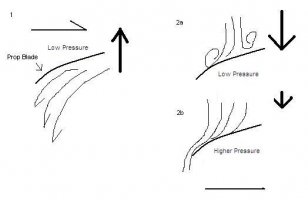
I understand your airplane prop analogy. But, an airfoil operates on a totally different principle than a marine propeller. So, here is what I see in my mind. Please correct my logic.
Under power, the screw spins. The blade pushes against the water at an angle causing some water to move backward and the boat to move forward (Newtons 3rd law). There is also a transverse force causing "prop walk". (fig 1)
While sailing, with the prop locked (fig 2a), or to an even greater extent, with the transmission in reverse, the exact opposite condition exists. In this case, the water pushes against the blade, causing resistance and slowing the boat.
With the prop in neutral (fig 2b) as the water comes by, the prop is free to move out of the way, reducing drag. Right? This is for fixed, not folding, props, of course. I guess I liken the rotary prop to an advanced paddle wheel, like on river boats. There is no way a locked paddle wheel offers less resistance than a free wheeling paddle wheel.
Anyway, I guess we should take this off-line but I can't attach files to the site e-mail. Thanks for bearing with me and I appreciate the Physics refresher.
-Chris
Jim Payton
04-07-2004, 08:45 PM
Chris and Seth, Please don't go off line for this discussion I find it very educational.
As for removing my outboard while sailing, that is next to impossible while single-handing within San Diego Bay. First the engine is pretty heavy and second I need to straddle the main sheet in order to lift and stow it out of the way, all while standing on the cockpit seat leaning over the life line.
My engine sets inside a well and in a doghouse behind the tiller, because of the transome design the engine cannot be tilted up out of the water, it must be removed from the well in order to get the prop out of the water. I really don't want to mount it on a bracket on the stern unless I absolutely have to.
While I am in the bay I usually just leave it in the water and sometimes I even leave the engine running in idle in case I need to put it in gear right away. On weekends the traffic can get pretty heavy on the water.
When I sail out of the bay there is usually plenty of time and room to lift her out of the water and stow on the stern rail bracket.
Jim Payton
04-07-2004, 08:54 PM
I tried to find a better picture but this is all I could find
WELL I TRIED THREE TIMES TO ATTACH A PICTURE AND IT STILL DOESN'T WORK. I GIVE UP!:boohoo:
Chris,
PLEASE accept my apologies if my tone was argumentative!! Definitely not where I as coming from, so no worries there. Mea culpa!
I am not an engineer, and I respect anyone's input who has the background you obviously have.
Back to the topic:
If I heard you right, you said an airfoil works on adifferent principle than a marine propeller. Maybe we are having a semantics issue... I understand that when we are talking about "lift" from sails vs. propeller issues (although they both produce "lift" as a portion of the forward thrust they produce).
I DO know that sails operate almsot exactly the same as wings (but upturned, of course), and keels produce lift in the water just like sails do above the water or wings do in the air.
Unless I am nuts, a foil is a foil is a foil-regardless of the medium they are working in.
My point on this topic is that I am familiar with Newton's 3rd, and equal and opposite....A prop under power deals with that part of it. It is also true that a fixed prop in the water is simply drag from the area exposed to the water flow-as you suggest. And...a free turning prop reduces some of that resistance.
BUT...my point is the "flat plate" area or the "disc", which is the diameter of the "disc" created by a spinning prop. With the prop spinning-airplane or boat, you have drag more or less equal to the "disc" diameter-which is MUCH greater than the drag of 2 stopped, fixed blades. The stopped prop is only dragging the surface of the blades, but not the whole "disc".
Please accept my lack of hard engineering on this, but I think in this context, the effect is the same in the air or in the water, and I can tell you from experience what happens if you don't stop an airplane prop from spinning if the engine quits, and also the significant speed increase if you stop a free spinning prop in the water. Go a step further and align the blades vertically before you lock the prop.
The paddle wheel comparision is a different thing- because you are not exposing the diameter of the ""disc" to the water/air like you are in a plane or conventioanl boat prop. In this case I think you are right-spinning is less drag.
That's my humble reply-unless I missed your point (I do that sometimes!). Thanks for your input here though, and sorry if I came off rude to you!
Good sailing!
Geoff Johnson
04-08-2004, 01:29 PM
I'm with Seth:
http://142.26.194.131/aerodynamics1/Multi/Page2.html
However, since I was fortunate enough to buy a boat with a Maxprop I can afford not to care. :)
stbdtack
04-09-2004, 01:47 AM
Ok , been following this thread. Gotta throw in my 2 cents.
I always heard of the spinning prop being more drag than a locked prop. BUT:
On my full keel cruising boat with a 20" 3 blade I get at least 3/4 knot MORE speed when I let the prop spin. As soon as I lock it down the speed drops. I usually lock it to cut down on cutlass bearing wear. I think the blade profile has a lot to do with the drag. Airplane prop = thin, high aspect....small area compared to the area covered when spinning. My prop= large blade area....much closer to the area covered when spinning.
I do know that the boat is faster when the prop free-wheels.
Once my E-38 is back in the water I will try the test with my 2 blade sailor prop.
Observation on the airplane prop discussion , Dont confuse a stopped prop with a stopped "feathered" prop.
Also, Hurth can be freewheeled at sailing speeds as the output gear shaft is in the oil bath and carries oil up to the other moving parts.
Ben (loving the discussion)
Geoff Johnson
04-09-2004, 11:45 AM
Google indicates we are reinventing the wheel here. It also seems that the answer might be more complicated ... least drag with freewheeling, more drag with a fixed prop and the most drag with the prop freewheeling at 1/2 the speed of a freewheeling prop:
http://lists.samurai.com/pipermail/trawler-world-list/2003-October/064860.html
http://www.endeavourowners.com/dscsn/systems/propulsion/frewhl.html
Of course, much of this thread has been very general, and as Ben says there are many different kinds of propellers and tranny's-which may affect the freewheeling speed, etc. The point is that in evaluating all of this, make sure it applies to the set up on your boat.
Ben, on the airplane propeller point, I did not confuse a stopped prop with a feathered one-obviously a feathered stopped prop is the lowest drag configuration, but for a plane with a fixed pitch prop, you are better off stopping it than letting it spin if you happen to turn your plane into a glider-right?
Thanks to all for keeping this a fun and informative thread!
Seth
Chris Rau
04-09-2004, 05:36 PM
Wow! I didn't expect to open up such a multi-faceted discussion. But I appreciate everyone's insight and research. So, it looks like there is no absolute rule for the question of locked-or-freewheeling. And it appears that we are not the first to broach the topic. It is common to see discussions ad-nauseum in sailing circles and web sites.
Furthermore, it appears the correct process is to go sailing (twist my arm :p ) and run locked, then run freewheeling, and see which way is faster for your rig.
However, I think we all agree:
1. Lock the prop in REVERSE, not forward.
2. The HBW50 can run either locked or free without fear of damage to the transmission.
3. A sailboat is not an airplane...usually. :egrin:
See you all on the water.
-Chris
escapade
04-10-2004, 11:01 AM
First for Jim; it is just fine to leave your outboard in neutral as the gears & bearings are bathed in oil at all times. No oil circulating pump is used in small outboards.
Second for Chris; remember from science class that air is really a liquid, as is water. Only water, being more dense, multiplys the effects. Please continue this discussion on line as I know what personal experience has shown but really would like more knowledge on the subject
Bud E34 "Escapade"
Jim Payton
04-10-2004, 11:15 AM
You guys are the best!!!
I agree with Chris let's go sailing and try locked and unlocked and see which gives the best speed and report back. Number of blades and diameter of prop, etc. might help us to configure some kind of chart.
I don't know if it is really worth doing all that, unless you are an avid racer (I am not), but going sailing always sounds like a good idea to me:cheers:
Tom Plummer
04-10-2004, 02:04 PM
Back in July of 2000 Practical Sailor did a PS advisor on prop drag and concluded "The July 15 PS Advisor had to do with drag. The conclusion was that considerable reduction in drag is available if the prop, in the open, is allowed to free-wheel. If th..."
Bill Sanborn
04-10-2004, 04:58 PM
I have had the loose zinc problem twice, both times with the same brand of zincs. The problem zincs are Canadian, appear to be larger and have a small copper or brass button in the inside where it can contact the shaft. I have had the best luck with "Sea Shield" Metal Guard". My diver has also seen this problem on other boats.
Re engaging the transmission while sailing, in reverse you are less likely to snag the gearshift lever with the main sheet when you tack.
Ed Balun
04-12-2004, 08:10 PM
Hi Sean. Apparently you still have your boat. Glad to hear it. My manual states to sail in reverse to prevent unnecessary trans. wear. Had a new trans. installed in my E-32-3 last July. 1800 total. If the trans is slow shifting, check the fluid level. The 50 only holds about 10 oz. If you hear a hi pitched squeal, that is the bearings burning up. Trust me.. I know!
Sean Engle
07-16-2004, 08:58 PM
I tried to find a better picture but this is all I could find
WELL I TRIED THREE TIMES TO ATTACH A PICTURE AND IT STILL DOESN'T WORK. I GIVE UP!:boohoo:
Try it now, Jim - you can post one or four images in a single post. Please make sure they're not HUGE though... (like exceeding 800x600).
Thanks,
//sse
Powered by vBulletin® Version 4.1.4 Copyright © 2012 vBulletin Solutions, Inc. All rights reserved.